
🏘️ Vintage Shitamachi · Living History
Yanaka Old Tokyo Tour
Explore with a local private guide through old shitamachi — the Tokyo that time forgot...
Yanaka escaped wartime destruction and remains one of Tokyo's most authentic historical quarters. Its narrow back alleys, historic residential boundaries, and sprawling local craft legacy showcase a vibrant community charm that preserves the historic heart of old downtown Tokyo. Our route opens with an open-air stroll through Ueno Park before settling into Yanaka's quiet backstreets.
Before diving into the quiet residential backstreets of Yanaka, our path winds through the open-air heritage sites of Ueno Park. We completely bypass the crowded museum halls and indoor tourist queues to focus on the park's dramatic outdoor history:
Shinobazu Pond — walking the scenic boardwalk path surrounded by massive, blooming lotus fields.
Kiyomizu Kannon-do — an authentic 1631 temple platform overlooking the famous "Moon Pine" loop, built by the same samurai-era architects who designed Kyoto's landmarks.
Ueno Toshogu Shrine — a spectacular, gold-leafed samurai sanctuary that completely escaped wartime destruction.
This keeps the day moving outdoors at a steady walking pace, seamlessly bridging the gap between modern Tokyo transit hubs and the vintage shitamachi atmosphere of Yanaka.

Yanaka Cemetery sprawls across 10 hectares in the heart of old Tokyo — a maze of cherry-tree-lined avenues, weathered stone monuments, and family plots that has served as the resting place for some of Japan's most significant historical figures since it opened in 1874. The last Tokugawa shogun, Tokugawa Yoshinobu, is buried here, along with numerous writers, artists, and statesmen of the Meiji era. Unlike the manicured formality of Western cemeteries, Yanaka feels more like a quiet park that happens to contain graves — local residents walk their dogs along its lanes, cyclists cut through on their daily commute, and the boundary between the cemetery and the surrounding neighbourhood is almost imperceptible. The central avenue, lined with around 180 cherry trees, has been a celebrated hanami (blossom-viewing) spot since the Edo period, when this entire area was a fashionable destination for cherry blossom outings from central Edo.

Yanaka's relationship with cats goes back generations and has become inseparable from the neighbourhood's identity. The area escaped both the 1923 Great Kanto Earthquake and the firebombing of the Second World War relatively unscathed, leaving a dense maze of narrow lanes, wooden houses, and small gardens that turned out to be ideal cat habitat — plenty of nooks, sunny ledges, and residents who have fed and cared for the local strays for decades. The cats themselves are semi-feral but thoroughly socialised, used to being photographed and occasionally fed by visitors, and have become such a fixture that local shopkeepers have built an entire micro-economy around them. Statues, paintings, and cat-shaped everything appear in shop windows throughout the lanes, and several elderly residents are locally famous simply for being the people who look after particular cats. Walking slowly through these backstreets, camera ready, is as much the point as any single landmark.
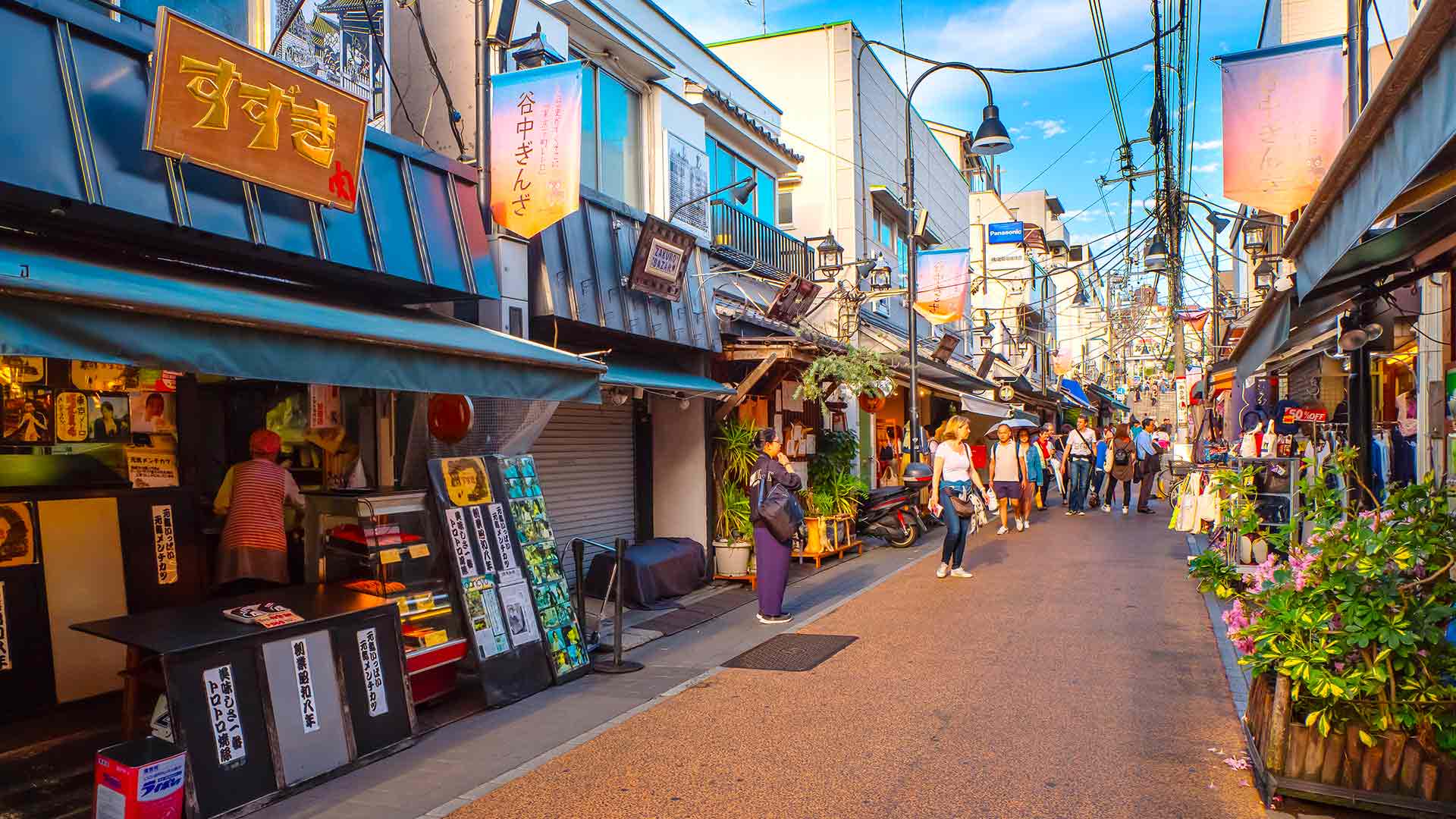
Yanaka Ginza is a 170-metre shotengai (shopping street) that has retained the look and rhythm of a 1950s Tokyo neighbourhood market almost entirely intact. The approach from Yanaka Cemetery down the Yuyake Dandan — the "sunset steps," named for the view of the sun setting directly down the length of the street — sets the scene before you even arrive: a slightly sloped lane of roughly 70 small shops selling fresh fish, handmade senbei (rice crackers), traditional sweets, secondhand clothing, ceramics, and an enormous variety of croquettes and skewered snacks meant to be eaten while walking. Unlike more polished retail streets elsewhere in Tokyo, Yanaka Ginza is unmistakably a working shopping street for the people who actually live in the surrounding lanes, which gives it an everyday authenticity that's increasingly rare in central Tokyo. The street has appeared in numerous films and TV dramas precisely because it looks like "old Tokyo" without needing any set dressing.
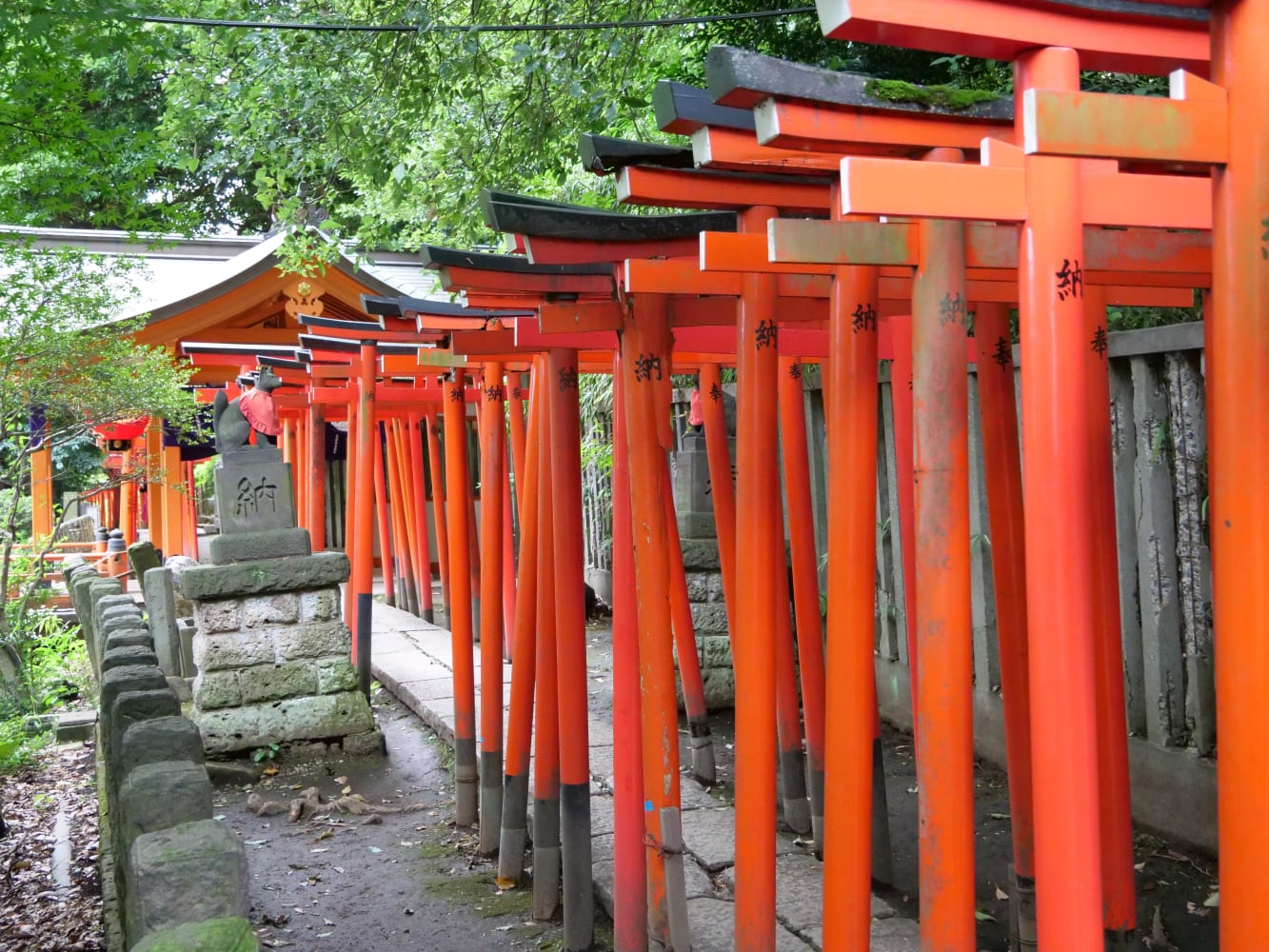
Yanaka contains more than 70 Buddhist temples within an area you can walk across in under half an hour — a density that exists because this district was designated a temple relocation zone during the early Edo period, when the shogunate moved dozens of temples here from central Edo to create firebreaks and free up land for the expanding city. Many of these temples retain their original Edo-period wooden halls, since Yanaka was spared the worst of the 1923 earthquake and the 1945 firebombing that destroyed most of historic Tokyo. Walking the temple lanes means passing through a constantly shifting sequence of small gates, modest main halls, old cemeteries, and quiet gardens, each temple usually tending to a specific sect and often associated with a particular family or guild going back generations. The atmosphere is unhurried and lived-in — these are working temples serving their local parishioners, not museum pieces, and many have no admission fee or formal visiting hours at all.

Over the past two decades, Yanaka's stock of old wooden townhouses, storehouses, and disused public buildings has quietly become one of Tokyo's most interesting concentrations of contemporary art spaces. Rather than purpose-built white-cube galleries, these are adaptive reuse projects — a 200-year-old public bathhouse converted into an exhibition space, a former sake warehouse now housing ceramics studios, traditional machiya townhouses repurposed as artist ateliers and small project spaces. The most celebrated of these is SCAI The Bathhouse, occupying the former Kashiwa-yu bathhouse and now one of Tokyo's most respected contemporary art galleries, showing both Japanese and international artists in a space that still bears the distinctive sloped ceiling and proportions of its original use. The juxtaposition of cutting-edge contemporary art inside Edo and Meiji-era architecture, scattered through quiet residential lanes, gives this part of Yanaka a texture found almost nowhere else in the city.
High-comfort walking shoes recommended. All experiences are strictly private — just you and Terry.
Groups of 5–6 guests: please inquire — rates scale to ¥120,000 to protect margins on the additional food and time.
* Terry's personal transit, food & snacks also included — no hidden costs on the day.
Everything is covered in your flat rate — no out-of-pocket costs on the day. Terry pays every stall, café, and transit gate quietly in the background.
High-comfort walking shoes recommended. All experiences strictly private — just your group and Terry, at your own pace.
Every Yanaka tour moves at your pace through one of Tokyo's most unhurried neighbourhoods. Fascinated by the old cemetery and Edo-era history? Terry slows right down and the stories come out. More interested in the shotengai craft shops and local food? The route tilts that way instead. You set the mood — Yanaka does the rest.
Check Terry's calendar availability and submit your tour booking request instantly.