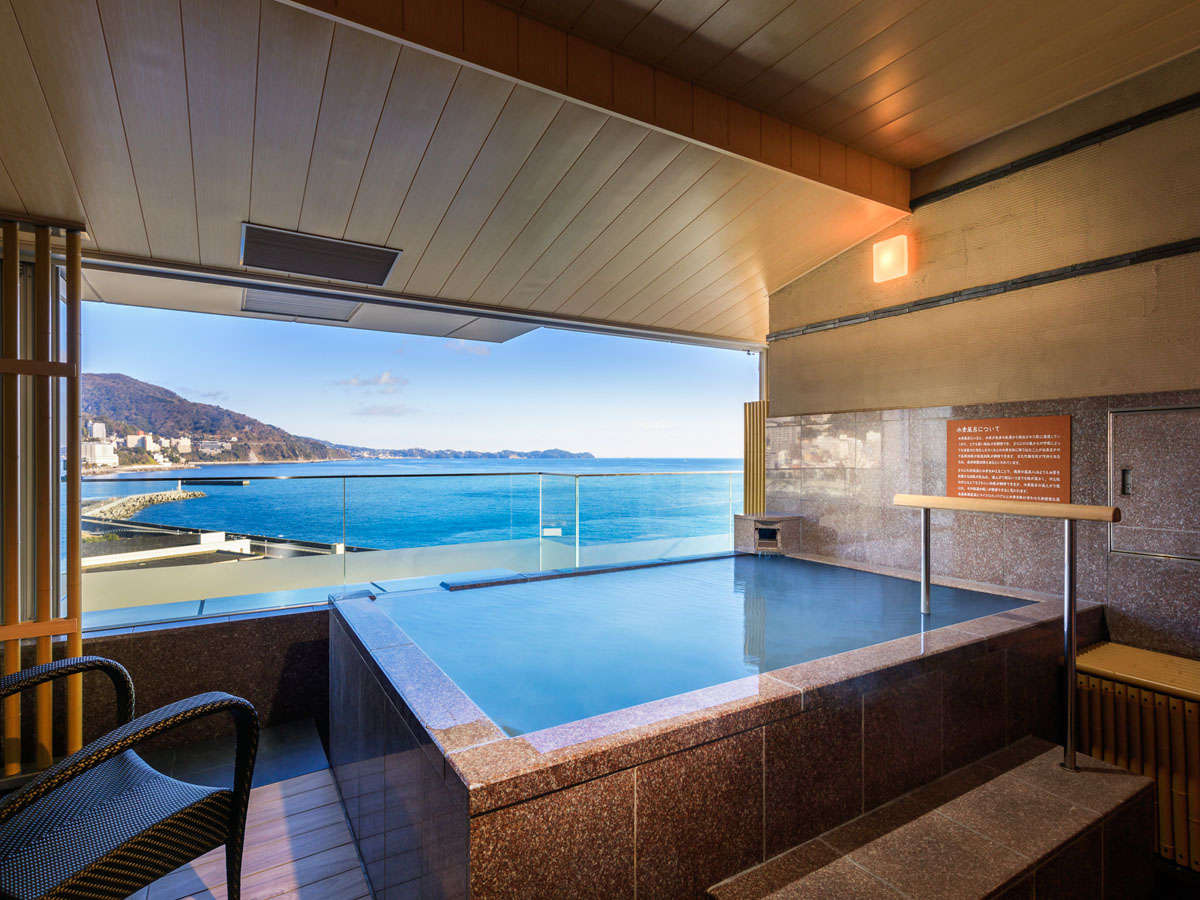
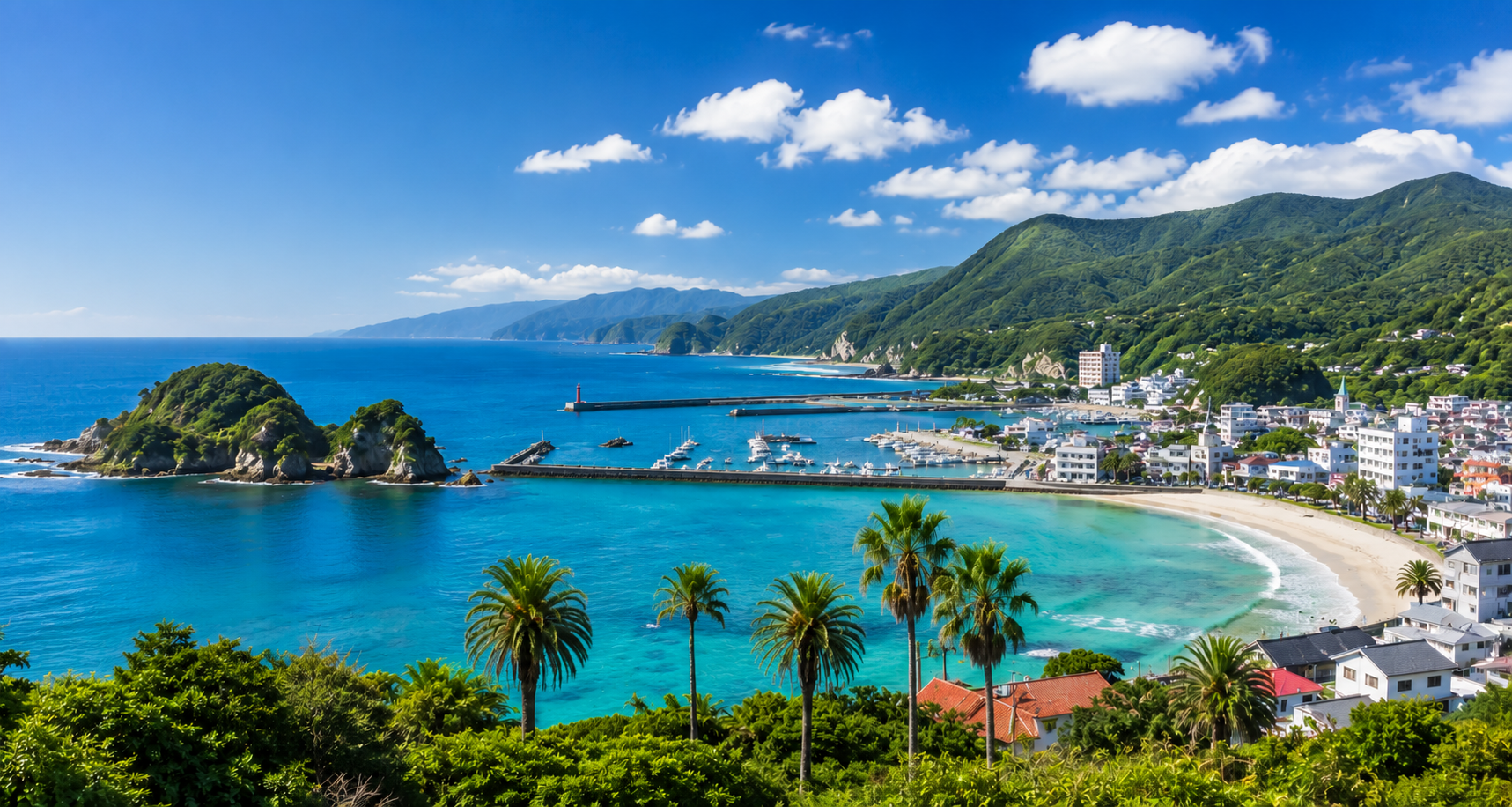
The coastline of the Izu Peninsula near Shimoda and Atami
⛵ Black Ships · Coastal Seafood · Onsen Town

Shimoda & Atami

Follow the route of Commodore Perry's Black Ships to the port that opened Japan to the world — then ride the coastline back through the hot spring town of Atami and its extraordinary hilltop museum.

Black Ship History · Kinmedai Seafood · Izu Coastline · Onsen Culture · World-Class Art

At the southern tip of the Izu Peninsula sits Shimoda — a small port town that carries an outsized weight in Japanese history. It was here in 1854 that Commodore Perry's fleet anchored and Japan's two centuries of self-imposed isolation from the West effectively ended. Today Shimoda is a place of white sand beaches, fresh seafood, candlelit alleyways, and a pace of life that belongs entirely to the coast. On the return north, Atami's long promenade walk from the station to the sea, the spectacular MOA Museum of Art perched above the bay, and the deep tradition of onsen make this one of the most varied and rewarding day trips available from Tokyo.

Major HubAtami Station · JR Tokaido/Shinkansen from Tokyo
Tour PaceRelaxed · ~6,000 Steps · Coastal & Hillside Walks
Transit TipJR Pass or Tokaido Line from Tokyo Station
Best TimingFull Day · Early Shinkansen Departure
Vibe ExpansionExtends to Shimoda via Izu Kyuko Line
Highlights
Day One · Shimoda — Black Ships & the Coast
A willow-lined canal walk along Perry Road in Shimoda
Stop 01 · Historic Streetscape — Morning · 10:00 AM
Shimoda's Most Storied Canal Walk

Perry Road

ペリーロード
📍 View on Google Maps ↗

Perry Road is the quiet heart of historic Shimoda — a short canal-side street paved with stones worn smooth over two centuries, lined with weeping willows and white-walled Edo-period storehouses that have been converted into cafes, kissaten (old-school coffee shops), galleries, and small restaurants. The road takes its name from Commodore Matthew Perry, whose delegation from the Black Ship fleet walked this same path in 1854 when they came ashore to negotiate the Convention of Kanagawa — the treaty that cracked open Japan's closed borders and changed the course of East Asian history. A bronze bust of Perry stands near the harbour end of the street, looking considerably more pleased with himself than the Japanese government of the time.

The street is best approached slowly. The storehouses, built from the dark timber and plaster construction typical of Edo-era merchant buildings, have an unusual quality of survival — Shimoda escaped much of the urban development that transformed other Japanese port towns, partly due to its relative remoteness at the tip of the peninsula. Walking the length of the street with Terry, who can fill in the layered history of each building and the geopolitical drama that played out here, transforms what might otherwise seem a pretty but unremarkable canal walk into a genuine connection with one of the most consequential moments in modern Japanese history.

💡 The small kissaten midway along the street serve excellent coffee in rooms that have barely changed since the Showa era. Terry recommends arriving early — the street is at its most atmospheric before the tour buses arrive, and the willows trailing in the canal water on a still morning are genuinely beautiful.
The historic Ryosenji Temple in Shimoda, site of the first Japan-US treaty negotiations
Stop 02 · National Historic Site — Mid Morning · 11:00 AM
Where Japan's Isolation Ended · 1854

Ryosenji Temple

了仙寺
📍 View on Google Maps ↗

Ryosenji is a small Buddhist temple at the end of Perry Road that carries one of the most significant designations in Japanese heritage: a National Historic Site. Its grounds are the exact location where the Convention of Shimoda was signed in June 1854 — the follow-up treaty that confirmed and expanded the terms of the Convention of Kanagawa, formalised trading rights, and established that American ships could take on water, food, and fuel at Shimoda and Hakodate. The document signed inside this temple effectively ended the Sakoku policy — Japan's 220-year programme of strict isolation from foreign contact — and set in motion the chain of events that would lead to the Meiji Restoration, the abolition of the samurai class, and the rapid transformation of Japan into a modern industrial state.

The temple's small museum, set within the main hall, displays artifacts relating to the Perry expedition and the early period of American-Japanese contact: treaty documents, navigational instruments, uniforms, photographs, and contemporary accounts from both sides. Some of the items are genuinely striking — the physical evidence of a negotiation conducted through interpreters, in a room like this one, between two cultures that had virtually no shared language or framework for the encounter. The grounds and main hall have been preserved with care, and the temple still functions as a working religious site, which gives the history an unusual quality of continuity.

💡 Entry to the museum is ¥500. Terry can explain the full political context of the Shimoda treaty in detail — the gap between what Perry actually achieved and how both sides interpreted the agreement afterwards is one of the more fascinating stories in 19th-century diplomacy, and it plays out in the artifacts on display here.
A Black Ship replica cruise boat docked in Shimoda Port
Stop 03 · Harbour & History — Late Morning · 12:00 PM
Active Fishing Port · Kurofune Sightseeing Cruise

Shimoda Port

下田港
📍 View on Google Maps ↗

Shimoda Port is a working fishing harbour and the anchor point of the town's identity — the deep natural bay that made it attractive to Perry's fleet is the same feature that makes it one of the most productive fishing grounds on the Izu Peninsula today. The port lands kinmedai (alfonsino, or golden eye snapper), Ise-ebi (Japanese spiny lobster), sazae (turban shells), and a variety of other species from the cold deep-water currents that sweep around the peninsula's southern tip, giving the local catch an exceptional quality that the fish markets and restaurants of Shimoda make full use of. The harbour front is lined with low buildings housing fish shops, rice crackers, dried seafood, and the kind of practical port-town commerce that survives largely unchanged from the Meiji era.

The Kurofune sightseeing cruise departs from the harbour and circles Shimoda Bay on a replica of one of Perry's Black Ships — a forty-minute trip that gives you the perspective of the American fleet approaching the bay in 1854 and a clear view of the coastline, the hills surrounding the town, and the islands offshore. The cruise is cheerfully kitsch and genuinely enjoyable, and the commentary (available in English) covers the Black Ship history with reasonable depth. On a clear day, the emerald water of Shimoda Bay seen from the boat is one of the most striking views in the Izu region.

💡 The Kurofune cruise costs approximately ¥1,500 and runs regularly from the harbour. Check the morning timetable with Terry on arrival — weather and season affect frequency. The fish shops along the harbour front sell excellent dried kinmedai and processed seafood as souvenirs; Terry knows which stalls have the freshest stock from that morning's landing.
The white sand and clear water of Shirahama Beach in Shimoda
Stop 04 · Coastal Escape — Early Afternoon · 13:30 PM
Izu's Most Beautiful White Sand Beach

Shirahama Beach

白浜海岸
📍 View on Google Maps ↗

Shirahama Ohama — White Beach — is one of the finest stretches of sand on the Pacific coast of Honshu: 800 metres of genuinely white, fine-grained sand backed by low coastal scrub, facing open ocean with the kind of clean surf that draws riders from across the Kanto region on weekends. The water is an unusually clear shade of blue-green, the result of the deep offshore trench that brings cold, nutrient-rich currents close to the peninsula's tip — the same oceanographic feature that makes the local seafood exceptional. In summer the beach fills with swimmers and surfers; outside peak season, particularly in spring and autumn, it is often nearly deserted, and the combination of the white sand, the Pacific horizon, and the mountain backdrop makes it one of the most quietly beautiful spots accessible by train from Tokyo.

The beach is about a ten-minute taxi or bus ride from Izukyu-Shimoda Station, making it an easy addition to a Shimoda day without requiring a car. Along the shore there are a few surf shops and casual seafood restaurants serving teishoku (set meals) with the morning's catch — this is a good place for a relaxed lunch, eating on or near the sand, before continuing the afternoon. On a two-day trip, Shirahama is the natural base for an unhurried morning — walking the shoreline, watching the surf, or simply sitting with coffee from one of the shack-style cafes that operate on the beach in the warmer months.

💡 Shirahama is best outside the official summer swimming season (mid-July to August), when the crowds are at their worst. Spring and early autumn offer beautiful conditions with a fraction of the visitors. The surf is consistent year-round — Terry can point you to the best vantage point for watching riders work the break.
A plate of kinmedai alfonsino, a seafood specialty of the Shimoda area
Stop 05 · Signature Dish — Afternoon · 15:00 PM
Japan's Finest Kinmedai · Port-Fresh Seafood

Kinmedai Seafood

金目鯛料理
📍 Find restaurants near Shimoda Port ↗

Shimoda Port ranks first in Japan for kinmedai (alfonsino) production — the deep-bodied, vivid red fish caught from the cold waters south of the peninsula is the defining ingredient of Izu cuisine and the dish that serious eaters come to Shimoda specifically to eat. Kinmedai has a tender, richly flavoured flesh with a higher fat content than most white fish, which makes it exceptional in either of its two classic Shimoda preparations: nitsuke (braised slowly in soy sauce, sake, and mirin until the fish is soft and the sauce has reduced to a deep, sweet-savoury glaze) and as sashimi, where the natural sweetness and fine texture of the raw flesh needs nothing except fresh wasabi and a good soy.

The restaurants near Shimoda Port are among the best-value serious seafood restaurants in Japan — the combination of direct local supply, decades of accumulated technique, and a clientele that knows the difference means that a kaisendon (rice bowl with sashimi) or a full kinmedai set meal here is typically better, and cheaper, than the equivalent at a Tokyo restaurant sourcing the same fish. Ise-ebi (Japanese spiny lobster), grilled or served as part of a sashimi spread, and sazae (turban shells grilled with butter and soy directly in the shell) are equally worth ordering when in season. Terry knows which restaurants have the best relationships with the port and can steer you directly to the right table.

💡 The kinmedai nitsuke set meal — braised fish, rice, miso soup, and pickles — is the essential order. Budget ¥2,000–3,500 for a full meal. For an elevated experience on a two-day trip, Terry can help arrange dinner at one of the older Shimoda ryokan restaurants, where the multi-course kaiseki meal is built entirely around that day's catch.
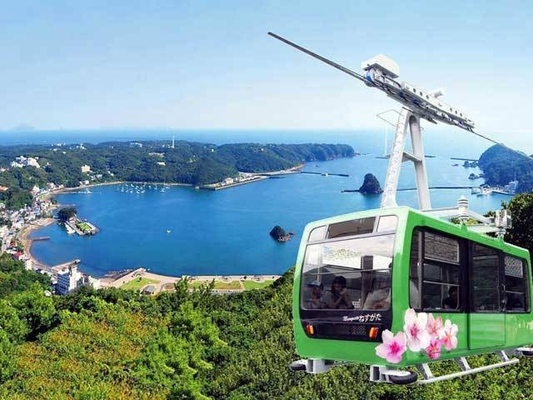
A cable car ascending Mt. Nesugata with panoramic views over Shimoda
Stop 06 · Panoramic Views — Late Afternoon · 16:00 PM
Summit Views · Shimoda Bay & Pacific

Mt. Nesugata Ropeway

寝姿山ロープウェイ
📍 View on Google Maps ↗

The Shimoda Ropeway cable car departs from directly beside Izukyu-Shimoda Station and climbs in three minutes to the summit of Mt. Nesugata — a small peak whose name means "reclining figure", after the outline the mountain makes against the sky when viewed from the town below. The summit, at around 200 metres, offers a 360-degree panoramic view across Shimoda Bay and the harbour, south over the Pacific horizon, east to Cape Suzaki and the rugged coastline of the southern peninsula tip, and on clear days north towards the distant bulk of the Izu highlands. It is one of those perspectives that fundamentally changes how you understand the geography of a place — the port that seemed like a busy waterfront at ground level reveals itself as a small town tucked into a natural harbour of exceptional beauty, surrounded by forested hills dropping steeply into the sea.

The summit also has a small garden with cherry trees, a shrine, and walking paths that loop through the hilltop vegetation. In spring, the combination of cherry blossom, sea views, and the particular quality of coastal light makes this one of the most photographed spots on the peninsula. The ropeway runs throughout the day and the journey takes only a few minutes each way, making it an easy late-afternoon addition to a Shimoda day that gives you a final, definitive view of the bay before heading north to Atami or settling in for the night on a two-day trip.

💡 The ropeway costs approximately ¥800 return. Arrive at the summit at least 45 minutes before sunset on a clear day — the light over Shimoda Bay in the late afternoon is exceptional, and the change in colour as the sun drops over the hills behind the town is worth timing the visit around.
Day Two (or Return Journey)
Atami — Onsen Town & the MOA Museum
North along the Izu Kyuko Line · Approx. 90 min from Shimoda · 40 min from Tokyo by Shinkansen
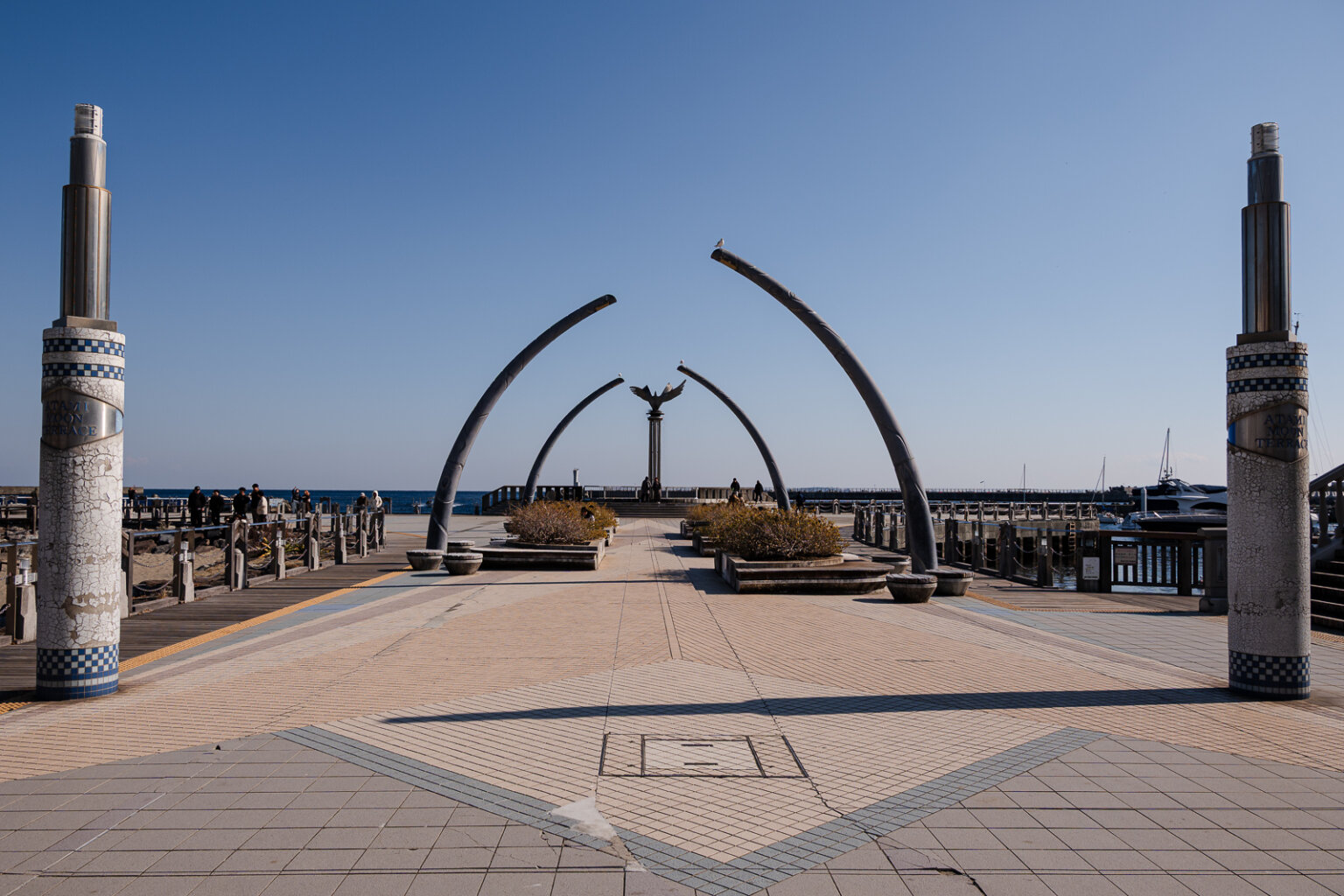
The seaside promenade in Atami running from the station toward Sun Beach
Stop 07 · Seaside Walk — Morning · 10:00 AM
Station-to-Sea Promenade · Atami Sun Beach

Atami Promenade Walk

熱海プロムナード · アタミサンビーチ
📍 View on Google Maps ↗

Atami station sits high above the town on a hillside shelf, and the walk from the station exit down to the seafront is one of the more pleasurable descents in any Japanese coastal resort: a gradual slope through the shopping streets and backstreets of the central town, past small izakayas and dried fish shops and the occasional onsen sign glowing amber in a side alley, opening eventually onto the Itogawa Promenade that runs along the beachfront. The name Atami means "hot sea" — a reference to the submarine hot springs that heat the bay floor and give the water an unusual warmth even in the cooler months — and the town has been a popular resort since the Edo period, when the shogun Tokugawa Ieyasu reportedly bathed in the springs here. The promenade walk captures the layered character of the place: the faded resort glamour, the active fishing port elements, and the contemporary cafe culture that has moved into many of the old buildings.

Atami Sun Beach at the far end of the promenade is a crescent of dark sand facing Sagami Bay, with sculptures and artworks positioned along the beachfront path — a quieter, more contemplative spot than the white-sand beaches of Shimoda, but with the particular quality of a resort town beach that has been loved for a very long time. The sea views extend across the bay to the silhouettes of the Izu Oshima and Hatsushima islands on clear days. Terry's recommended pace is a slow walk down, stopping for coffee or a morning pastry at one of the cafes along the way, arriving at the beach with enough time to walk the sand before heading uphill to the MOA Museum.

💡 The walk from Atami Station to Sun Beach takes approximately 20–25 minutes at a comfortable pace. The Atami Ginza shopping arcade is a worthwhile detour on the way — a covered shotengai with good local snack shops, fresh fish counters, and the famous Atami Purin pudding shop that locals queue for.
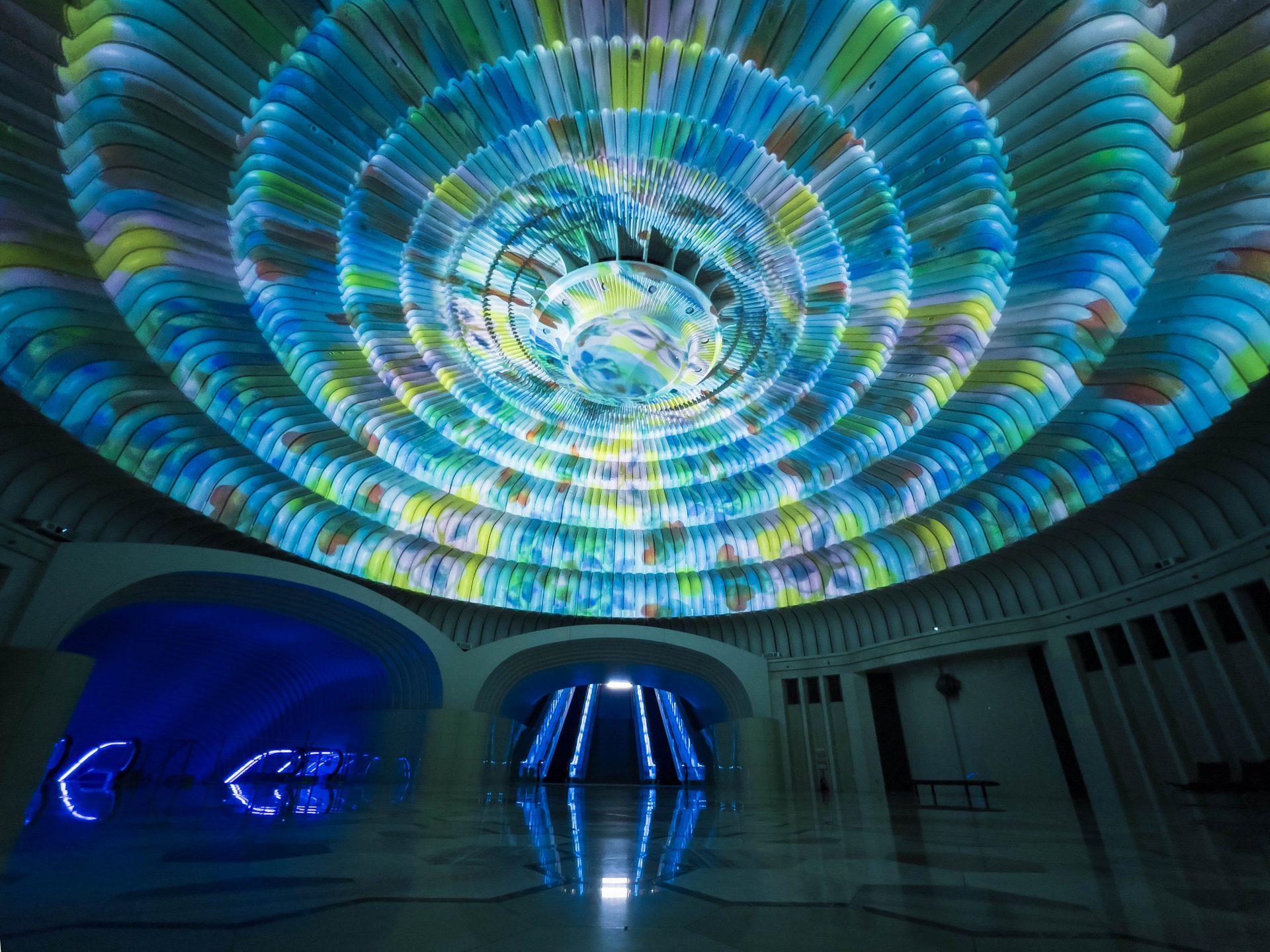
The kaleidoscope installation inside the Circular Hall of the MOA Museum of Art in Atami
Stop 08 · World-Class Museum — Late Morning · 11:30 AM
Three National Treasures · Golden Tea Room · Sagami Bay Views

MOA Museum of Art

MOA美術館
📍 View on Google Maps ↗

The MOA Museum of Art sits on a hilltop at 250 metres above Atami, overlooking Sagami Bay through 236,000 square metres of carefully maintained gardens. The approach alone is an experience: from the bus stop at the base, seven escalators carry you through a 200-metre illuminated tunnel rising 48 metres in height, emerging into a circular hall where an enormous kaleidoscope projection — 20 metres in diameter, 10 metres high — fills the space with slowly rotating patterns of colour and light before the galleries begin. The museum was originally opened in 1982 and comprehensively redesigned in 2017 by the New Material Research Laboratory of artist Hiroshi Sugimoto and architect Tomoyuki Sakakida, who used yakusugi cypress from 1,500-year-old trees in Kagoshima and hand-applied urushi lacquer entrance doors by a Living National Treasure to create interiors that are themselves works of art.

The collection of approximately 3,500 works includes three National Treasures — Japan's highest cultural designation, awarded to fewer than 900 objects nationwide. These rotate on display and include Ogata Korin's Red and White Plum Blossoms folding screen (a masterpiece of Rinpa school painting from the early 18th century), Nonomura Ninsei's Tea-leaf Jar with wisteria design, and a calligraphy album spanning the Nara to Muromachi periods. The museum also houses a faithful full-scale recreation of Toyotomi Hideyoshi's Golden Tea Room, a complete Noh theatre with a cypress-bark roof, and a reconstructed townhouse of the artist Ogata Korin in the Sukiya architectural style. The hilltop gardens, with their seasonal plum blossoms, azaleas, and what MOA describes as one of Japan's latest autumn foliage seasons, wrap around the building on all sides with views across the bay.

💡 Entry is ¥1,600; plan a minimum of 2.5 hours. The patisserie in the museum, in collaboration with acclaimed pastry chef Toshi Yoroizuka, serves exceptional desserts using local Atami ingredients — the matcha soft-serve and seasonal sweets are worth building time around. Arrive at opening (9:30 AM) on weekdays for the escalator approach and Circular Hall at their quietest.
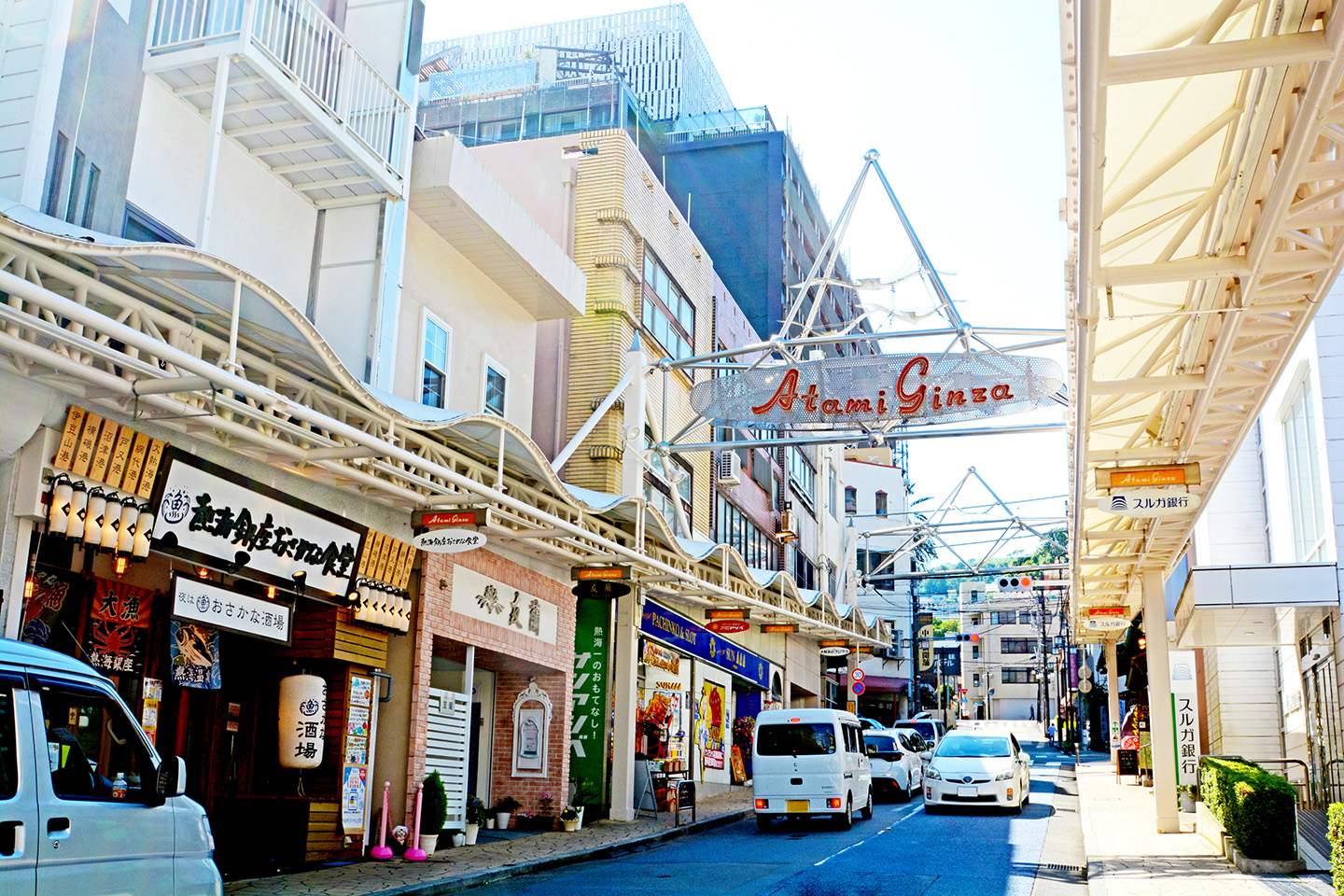
Street food stalls along the Atami Ginza shopping arcade
Stop 09 · Local Shopping — Early Afternoon · 14:30 PM
Covered Shotengai · Seafood Snacks & Local Produce

Atami Ginza

熱海銀座
📍 View on Google Maps ↗

Atami Ginza is the main covered shopping arcade in the centre of town — a classic shotengai of the kind that once existed in virtually every Japanese town and now survives in fewer and fewer places. The arcade runs parallel to the promenade behind the seafront, a single covered street where fresh fish shops, dried seafood stalls, izakayas, confectionery shops, small restaurants, and souvenir sellers operate in the dense, practical arrangement that characterised Japanese commercial streets before the arrival of shopping malls and convenience stores. The atmosphere is genuinely local — this is where Atami residents shop, not a tourist recreation of a shopping street — and the quality of the produce reflects the town's direct access to the fishing port.

The signature purchase at Atami Ginza is himono — the dried and lightly preserved fish that is both a local speciality and one of the great Japanese breakfast dishes. The drying technique concentrates the flavour of kinmedai, aji (horse mackerel), and saba (mackerel) to an intensity impossible in the fresh fish, and the best producers in the arcade have been refining their salting and drying ratios for generations. Terry knows which stalls to visit and which specific products travel well — dried fish, in the right vacuum packaging, makes an excellent and genuinely local souvenir. The Atami Purin pudding shop at the beach end of the arcade has a devoted local following for its layered custard puddings in glass jars.

💡 Budget 45–60 minutes for the arcade. The best himono shops are towards the harbour end — look for stalls with fish hanging in wooden-frame drying racks rather than plastic-wrapped supermarket stock. Terry can help you read the labels and identify the producers worth buying from.
A traditional hot spring bath at an Atami onsen
Stop 10 · Restorative Close — Afternoon · 16:00 PM
Atami Onsen · Over 1,000 Years of Hot Spring History

Atami Onsen

熱海温泉
📍 Find day-use onsen in Atami ↗

Atami has been a hot spring resort for over a thousand years — the natural hot water that gives the town its name (hot sea) has been used for bathing since at least the Nara period, and the tradition of coming here from the cities to soak and recover is so deeply embedded in Japanese culture that Atami was one of the most popular domestic destinations in Japan for most of the 20th century. The springs produce a sodium chloride water known for its benefits to skin and circulation, and the town's ryokan and public bath facilities range from the grand resort hotels that line the hillsides above the bay to small, atmospheric public baths (sento) in the side streets of the town centre that have been operating continuously for decades.

For a day trip, the most practical option is a day-use bath (higaeri onsen) at one of the mid-range ryokan near the station or seafront — many offer two-hour bath access for ¥1,000–2,000 without requiring an overnight stay. The better facilities include outdoor baths (rotenburo) with views over the bay or the hills, indoor pools of different temperatures, and the particular quality of steam and mineral smell that distinguishes a proper hot spring from a heated swimming pool. After a full day walking Shimoda and Atami, this is the right way to end — soaking in water that has been coming out of the ground at this same temperature for a thousand years, looking out over the bay as the afternoon light shifts.

💡 Terry can recommend the best day-use facilities based on what's available and your preference for scale and atmosphere — from intimate neighbourhood baths to full ryokan facilities with multiple pools and private baths. Bring a small towel, or rent one on-site. Most onsen require full immersion without swimwear; tattoos are prohibited at most facilities.

All-Inclusive Tour Rates

Two options — a premium 2-day experience based in Shimoda, or a 1-day express version for those short on time. All rates include Terry's guiding, transit, hotel (2-day), all admissions, and meals.

Option A — Premium 2-Day Tour (Recommended)

Covers 2 full days of guiding, Terry's hotel stay in Shimoda, all transit, all admissions, and all meals. Long-distance train from Tokyo via JR Tokyo Wide Pass (¥15,000 — purchased independently by guests).

Solo

1 Guest
¥144,000 total
2 days all-inclusive
Terry's hotel & transit included

Couple

2 Guests
¥159,500 total
¥79,750 per person
Terry's hotel & transit included

Small Group

3 — 4 Guests
¥185,000 total
From ¥46,250 per person
Terry's hotel & transit included

Group

5 — 6 Guests
¥210,500 total
From ¥35,083 per person
Terry's hotel & transit included

Option B — Express 1-Day Tour

A 13-hour express day trip covering Shimoda only. Best for guests who cannot stay overnight. Long-distance train via JR Tokyo Wide Pass (purchased independently by guests).

Solo

1 Guest
¥70,000 total
Full 13-hour day
All admissions & lunch included

Couple

2 Guests
¥80,000 total
¥40,000 per person
All admissions & lunch included

Small Group

3 — 4 Guests
¥95,000 total
From ¥23,750 per person
All admissions & lunch included

Group

5 — 6 Guests
¥110,000 total
From ¥18,333 per person
All admissions & lunch included

* JR Tokyo Wide Pass (¥15,000/person) purchased independently by guests. 2-day guests arrange their own Shimoda hotel accommodation.

What's Included
  • Full private guiding and Black Ship diplomatic history commentary with Terry
  • All local coastal buses, museum shuttles, and hillside taxi transfers
  • Ryosenji Black Ship Museum entry (¥500/person)
  • Kurofune Black Ship Harbour Cruise (¥1,500/person)
  • Mt. Nesugata Ropeway (¥800/person)
  • MOA Museum of Art, Atami (¥1,600/person)
  • Day-use luxury ocean-view onsen hot spring (¥2,000/person)
  • Day 1: Premium Kinmedai snapper lunch in Shimoda
  • Day 2: Atami Ginza street food crawl and seafood lunch
  • Terry's personal transit, hotel stay (2-day), and admission fees
  • Day-use onsen recommendation & access coordination
Good to Know

Transport to and from Shimoda is not included in guiding rates. The Odoriko limited express from Tokyo/Shinjuku direct to Izukyu-Shimoda takes approximately 2.5 hours. The Tokaido Shinkansen to Atami (40 min) with connection to Izu Kyuko Line is the alternative route.

For a two-day trip, overnight accommodation in Shimoda is arranged independently — Terry can recommend ryokan and small hotels suited to different budgets and preferences. Rates for Day 2 Atami guiding are charged separately at the same daily rate.

Comfortable walking shoes are essential. One-day itineraries cover the highlights at pace; two days allows Shimoda and Atami each the time they deserve.

Why Two Days Makes the Difference

Shimoda is a long way from Tokyo — the journey takes 2.5 hours each way, which on a single day leaves limited time before the return train becomes a concern. One day is possible, but the rhythm is rushed: you see the highlights without really settling into the pace of the place.

Two days changes everything. The first evening in Shimoda — dinner at the harbour, the town quiet after the day-trippers leave, the possibility of an early morning walk along Perry Road before anyone else is up — is where the character of the place becomes clear. Atami then becomes a considered stop on the return rather than an afterthought, with real time for the MOA Museum and the promenade.

Terry's recommendation for first-time visitors: two days, overnight in Shimoda, and treat Atami as a full half-day on the way back to Tokyo.

Ready to book Shimoda & Atami?

Ten highlights, one or two days, the best seafood on the Izu Peninsula — check Terry's availability to get started.