🏙️ Youth Culture · Neon Horizons
Shibuya Modern Culture
Immerse yourself in the epicenter of global youth fashion, futuristic architecture, and hidden vinyl listening bars pacing Tokyo's trendsetting district.
Shibuya is far more than a crowded intersection; it is a continuously evolving canvas of subcultures and architectural innovations. Terry takes you behind the towering video screens to navigate micro-boutiques in hidden alleys, explore elevated park developments, and share stories of the post-war shifts that turned this valley into an international trend capital.

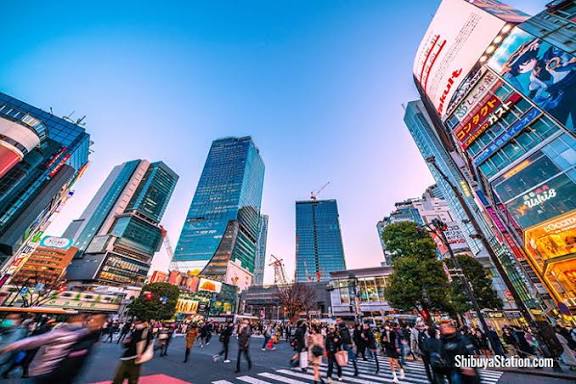
Shibuya Crossing is the busiest pedestrian intersection in the world, with as many as 3,000 people crossing in a single light cycle at peak times — five crosswalks converging simultaneously from every direction in a scene that has become one of the defining images of modern Tokyo. The crossing exists in its current form because of Shibuya Station's role as one of Tokyo's great rail interchanges, where multiple private and JR lines converge, and the area has grown around that transport hub since the early 20th century into one of the city's primary commercial and youth culture districts. Just beside the crossing sits the statue of Hachiko, the Akita dog who famously continued to wait at the station for his deceased owner's return every day for nearly a decade in the 1920s and 30s — a story that became a symbol of loyalty known throughout Japan and now a popular meeting point and photo spot. Beyond the crossing itself, the surrounding backstreets retain pockets of mid-century Shibuya, a quieter and more textured layer beneath the neon and giant screens.

Cat Street follows the route of a long-buried river — the Shibuya River was covered over decades ago, and the street that now runs above it has become one of Tokyo's most consistently interesting strips for independent fashion, tucked between the bigger crowds of Shibuya and Harajuku. Smaller international and Japanese designer boutiques line the route, with a noticeably different, more curated feel than the louder retail streets nearby. The walk ends at Miyashita Park, a striking piece of recent Tokyo redevelopment that reimagined an old elevated park as a multi-level complex combining a rooftop green space, shops, and food halls directly above the street-level retail — a literal layering of public space over commerce that exemplifies how Shibuya keeps reinventing its limited ground space. From the rooftop level, there are unusual views back over the Shibuya skyline from an angle most visitors never see.
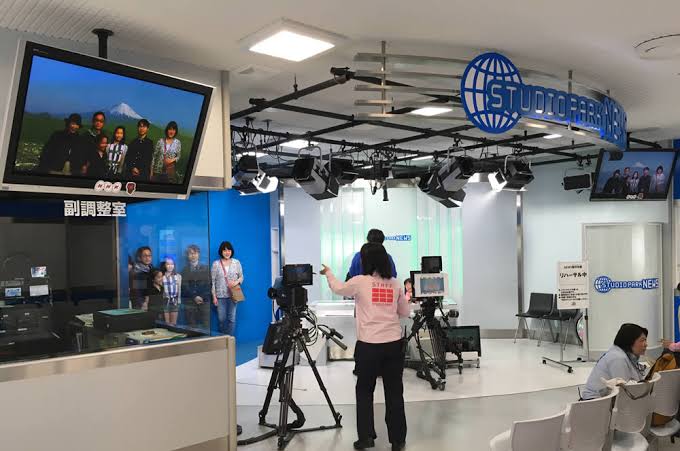
NHK — Nippon Hoso Kyokai, Japan's public broadcasting corporation — has been headquartered in this corner of Shibuya since 1973, occupying a vast complex of production buildings and broadcast facilities that represent the nerve centre of Japanese television. The Studio Park visitor attraction within the complex offers an unusually candid look behind the curtain of a working national broadcaster: real production studios visible through glass, replica news sets where visitors can sit at the anchor desk and read a broadcast, and exhibition spaces covering seven decades of Japanese television history from the first experimental broadcasts in 1953 through to present-day production techniques.
For anyone interested in how Japanese media works — and how profoundly television shaped the country's postwar culture — this is one of the most revealing stops in Shibuya. NHK's programming history mirrors Japan's own: the first televised sumo tournaments, the broadcasts of the 1964 Tokyo Olympics that introduced colour television to the country, the taiga historical dramas that still command national audiences every Sunday night. The complex sits in the broad green corridor of NHK Broadcasting Center Park, which provides a surprisingly calm walkway between the Harajuku and Shibuya sides of the neighbourhood.

Shibuya Sky sits on the roof of Shibuya Scramble Square — the 47-storey tower that completed the long-running redevelopment of the area directly above Shibuya Station and opened in 2019 as the tallest building in the district. The observation experience is genuinely well designed: a tunnel approach through an installation of suspended lights, a fast elevator to the 46th-floor indoor observation area, then an escalator up to the fully open-air roof deck at 229 metres — one of very few truly outdoor observation spaces in Tokyo, where there is nothing between you and a complete 360-degree panorama of the city.
Timed correctly, the late afternoon arrival catches the city in transition: the low western sun lighting the density of western Tokyo one direction, Shinjuku's towers clearly visible on the horizon, the Tokyo Skytree to the northeast, and directly below, the Shibuya Crossing itself reduced to something almost quiet-looking from this height, the famous scramble barely visible as a pale intersection between the buildings. As the sky darkens the view transforms entirely into a grid of light that extends in every direction to the edge of visibility. The best photographs from the deck come in that roughly thirty-minute window between sunset and full dark when both the sky and the city are lit simultaneously.
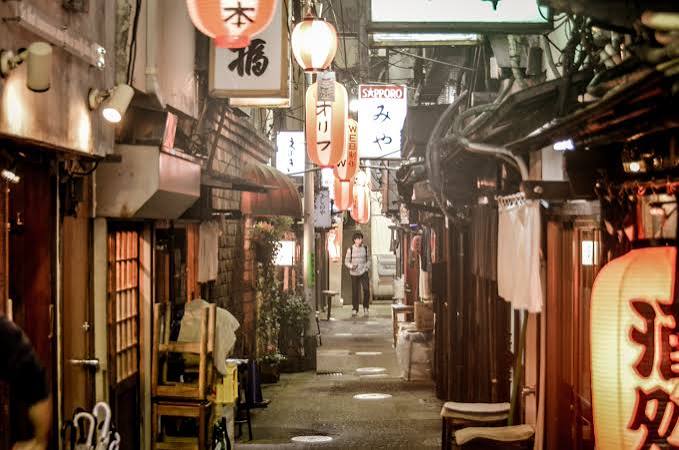
Nonbei Yokocho — the "drunkard's alley" — is one of the most atmospheric and least-expected corners of Shibuya: a pair of narrow lanes running behind the elevated train tracks just north of Shibuya Station, lined with tiny bars in wooden and corrugated-metal buildings that feel transplanted from a different era of the city entirely. The alley has been here since the postwar black-market years, when this strip developed as a drinking spot for the workers and traders who operated in the surrounding area, and while the clientele has changed over the decades the physical character of the place has remained remarkably intact — the low doorways, the paper lanterns, the smell of grilled food drifting from counter kitchens operating in spaces barely larger than a wardrobe.
Each bar in Nonbei Yokocho has its own distinct personality: some are tiny izakayas with a charcoal grill and three stools; others specialise in natural wine, Japanese whisky, or craft beer; a few have been run by the same owner for thirty or forty years and have the deeply specific atmosphere that comes only with that kind of accumulated time. The contrast with the mega-retail and neon spectacle of central Shibuya fifty metres away is extraordinary — this is one of those places that makes you realise how many different Tokyos exist simultaneously within a few minutes' walk of each other. Terry knows which doors are worth opening and which bars are most welcoming to visitors encountering this kind of place for the first time.
Due to extreme demand for sunset entry at Shibuya Sky, booking at least 4 weeks in advance is highly recommended.
* Terry's personal transit, admissions & meals are also included — no hidden costs on the day.
Everything is covered in your flat rate — no out-of-pocket costs on the day. Terry pre-books your Shibuya Sky sunset slot and settles every tab quietly in the background.
Shibuya pairs excellently with an early morning walk through the serene Meiji Jingu Shrine forest or a food excursion down the neighboring Daikanyama residential slopes.
All guiding experiences are strictly private with zero strangers or rigid tour bus schedules tracking your group.
Because navigating Shibuya's urban vertical malls and dynamic pedestrian avenues naturally requires adaptable footing, we move at your exact chosen pace. Since this is a completely tailored, private experience, Terry seamlessly adjusts plans to focus on specific high-end fashion lines, retro gaming arcades, or record markets smoothly.