
🌊 Coastal Zen · Shogunate History
Kamakura
A beautiful seaside town surrounded by forested hills, ancient Zen temples, and giant bamboo groves.
Kamakura served as the political capital of Japan during the Kamakura shogunate era from 1185 to 1333. Today, it is a highly popular destination renowned for its collection of beautifully preserved shrines and temples. Tucked into a natural valley framework facing the Pacific Ocean, it offers travelers an incredible mix of rich historical monuments and relaxed beachside market streets.

The Great Buddha of Kamakura — Kotoku-in Daibutsu — is a bronze statue of the Amida Buddha standing 11.4 metres tall and weighing approximately 93 tonnes, cast in 1252 during the Kamakura period when this coastal city was the seat of Japan’s military government and one of the most powerful cities in Asia. The statue was originally housed inside a large wooden temple hall, but two successive typhoons in the late 14th and early 15th centuries destroyed the building, and the Buddha has sat in the open air ever since — a fact that makes it visually unlike any other great Buddha image in Japan, framed by sky and hills rather than by gilded interior space. The patina of the bronze, weathered over seven centuries of ocean air, has settled into a grey-green that photographs never quite capture accurately.
The interior of the statue is accessible through small doors in the figure’s back — a hollow space that shows the extraordinary craft of its construction, the bronze cast in sections and joined with a precision that has held for nearly eight centuries. The face alone is over 2.3 metres from chin to crown, and standing at the base looking upward gives a sense of the scale that distant photographs consistently flatten. The surrounding temple grounds of Kotoku-in are modest and deliberately uncluttered, the attention directed entirely toward the figure itself, and the approach path through a small wooded gate creates the same kind of arrival sequence — the gradual reveal of something much larger than expected — that the builders clearly intended.
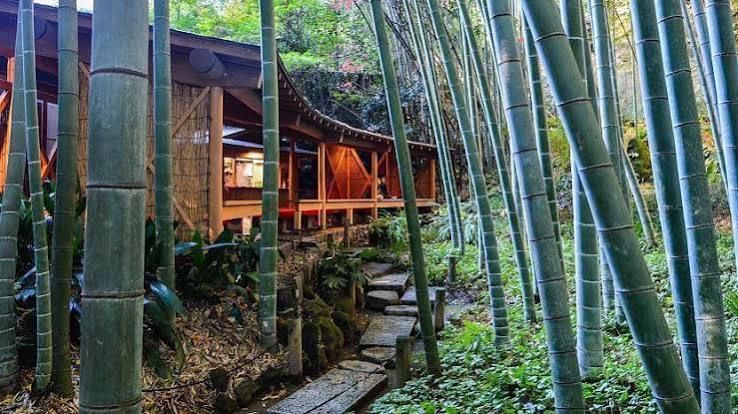
Hokoku-ji is a Rinzai Zen temple founded in 1334 whose grounds contain one of the most remarkable natural spaces in the Kanto region: a grove of approximately 2,000 moso bamboo (Phyllostachys edulis) growing so densely that the interior creates its own climate — cooler, quieter, and filtered to a particular quality of green light that exists nowhere else. Moso bamboo is the largest bamboo species in Japan, capable of growing 20 metres tall and reaching trunk diameters of 20 centimetres, and the grove at Hokoku-ji has been growing undisturbed for long enough that the individual culms form a canopy overhead that moves as a single structure in any wind. The sound — a deep, dry clicking and rustling of hollow stems against each other — is one of those sounds that, once heard, is immediately recognisable and impossible to forget.
The grove path winds for several hundred metres through the bamboo interior, emerging at a small traditional tea house set in a clearing where matcha is prepared and served overlooking the living walls of the forest. The combination of the walk through the grove and the tea at the end of it is one of the most perfectly sequenced visitor experiences in Kamakura — the physical immersion in the bamboo followed by the stillness of sitting with a bowl of matcha while the grove continues its slow movement around you. The temple main hall and the small graveyard of the Ashikaga clan, one of the feudal families that shaped the history of medieval Kamakura, sit beside the bamboo entrance and are worth a few minutes before entering the grove.

Tsurugaoka Hachimangu is the most important Shinto shrine in Kamakura and the spiritual and physical heart of the city — positioned on a rise at the northern end of the broad ceremonial boulevard Wakamiya-oji, which runs straight from the shrine to the sea, a distance of nearly two kilometres. The shrine was established by Minamoto no Yoritomo, the first shogun of the Kamakura government, in 1180 when he moved it to its current location and enlarged it into the grand complex that effectively defined the layout of the city around it. Yoritomo’s decision to build his military capital here, and to place this shrine at its centre, shaped the political history of Japan for the following century and a half — the shrine’s association with Hachiman, the Shinto deity of war and patron of the samurai class, made it the most politically charged religious site in medieval Japan.
The approach up the broad stone staircase flanked by seasonal plantings — cherry in spring, lotus in the ponds to either side of the main path, chrysanthemum in autumn — leads to the main hall rebuilt in 1828 after fire, its lacquered red and black exterior more visually elaborate than most Shinto shrines, reflecting centuries of patronage from successive shogunates. The great ginkgo tree that stood beside the main staircase for over a thousand years — behind which the third shogun Sanetomo was assassinated in 1219 in one of the pivotal moments of the Kamakura period — blew down in a storm in 2010, but new growth from the base has since reached several metres. Terry knows the full history of the site and can bring the medieval city it once commanded back into visible focus.
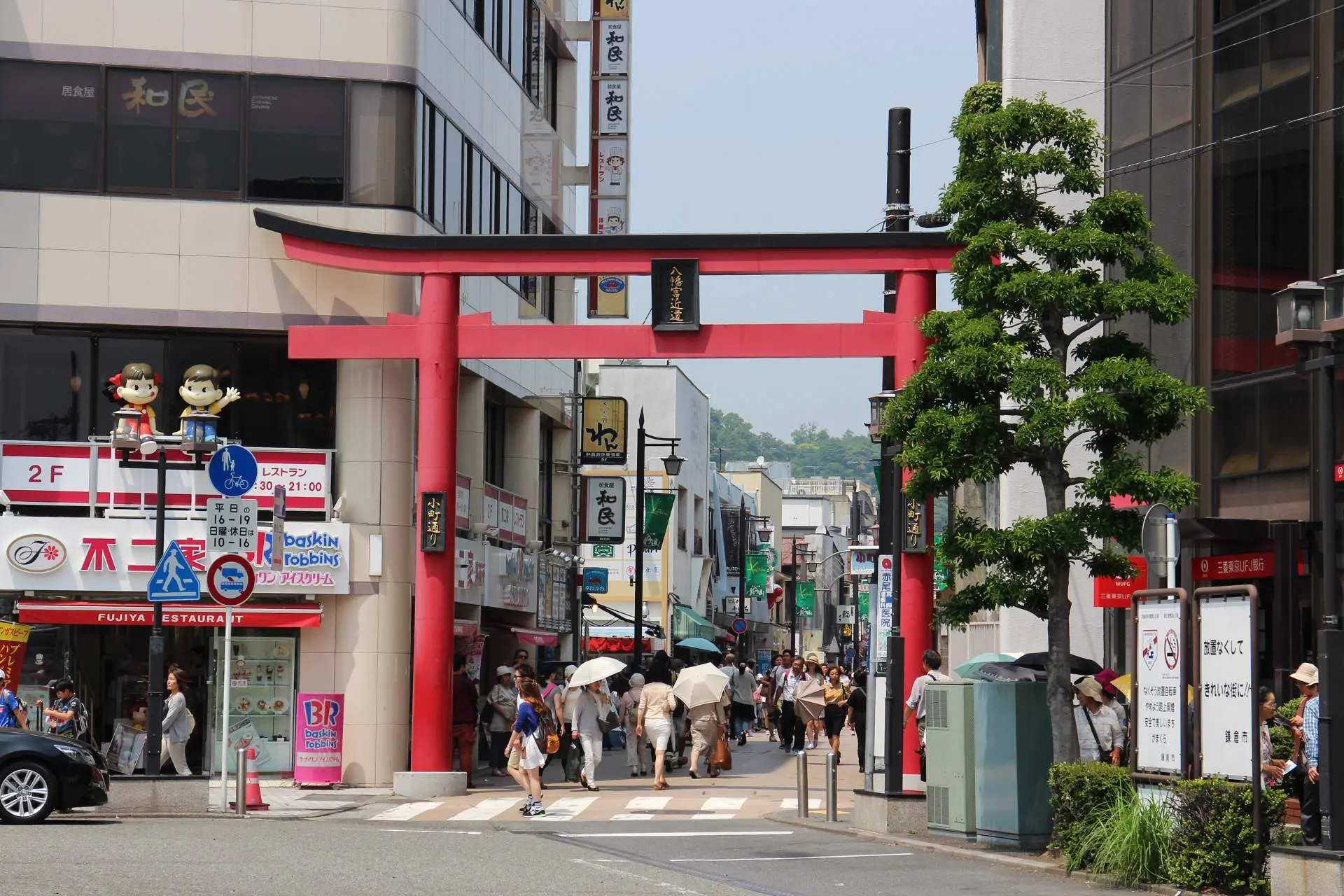
Komachi-dori is Kamakura’s main shopping street — a 350-metre pedestrian lane running from Kamakura station toward the approach to Tsurugaoka Hachimangu, lined with shops selling local crafts, traditional sweets, ceramics, lacquerware, and the particular food culture that Kamakura has developed around its identity as both a historic city and a coastal resort. The street has been a commercial thoroughfare since the medieval period when the same route served as one of the main arteries of the shogun’s capital, and while the merchandise has changed considerably since the 13th century, the lane’s function as the place where the city feeds, shops, and presents itself to visitors has remained constant. The mix of shops is notably better curated than comparable tourist streets in other Japanese cities, with a higher proportion of genuinely local producers and a lower density of generic souvenir merchandise.
The food on Komachi-dori reflects Kamakura’s dual identity as a Buddhist temple city and a seaside town: Zen-influenced vegetarian snacks sit alongside fresh fish from Sagami Bay, shirasu (whitebait) in every possible application — fresh on rice, dried, in pasta, and for the adventurous in ice cream — and the traditional wagashi sweets associated with the temple culture that has shaped the city’s food habits for seven centuries. The craft shops reward slow attention: several carry work by local potters and textile makers operating in studios in the surrounding hills, and the quality is consistently higher than what appears in the window at first glance. The street is best walked in both directions — the shops facing north toward the shrine and those facing south toward the station offer a different selection from each other, and the return walk is always more relaxed than the arrival.
The temples are somewhat spread apart. While the main core from the station to Tsurugaoka Hachimangu is easily walkable, you will want to utilize the local bus lines or the Enoden train line to access the Great Buddha and bamboo forests efficiently — all included in your flat rate, so Terry handles the tickets and gates.
All excursions are private and fully customizable—ensuring you move smoothly at your own ideal pace with Terry.
* Terry's personal transit, admissions & meals are also included — no hidden costs on the day.