This dynamic route bridges the ancient spiritual past with contemporary artisan mastery. Join this private guided tour of Tokyo as Terry guides you down the dramatic entryways of Senso-ji—Tokyo's oldest temple—through the vibrant retail backstreets of historic Asakusa, and directly into the wholesale blocks of Kappabashi, where top international chefs source handmade knives and culinary items.
Senso-ji is the oldest temple in Tokyo and one of the most visited religious sites in the world, receiving over 30 million visitors a year — yet most of them see only the main hall and miss the extraordinary layering of history compressed into its grounds. The temple's origins trace back to 628 AD, when two fishermen brothers named Hinokuma Hamanari and Hinokuma Takenari reportedly pulled a small golden image of the Bodhisattva Kannon from the Sumida River in their nets. The local chieftain, Nakatomo no Nakatomo, enshrined the image and dedicated his home as a place of worship. The temple that grew from that act of devotion has been rebuilt multiple times — most recently after the 1945 firebombing destroyed the main hall — but the site has been in continuous religious use for nearly 1,400 years.
The approach along Nakamise-dori is one of the great theatrical sequences in Tokyo: the outer Kaminarimon gate with its enormous 700-kilogram red paper lantern, then the 250-metre covered shopping street lined with over 90 traditional stalls selling senbei, ningyo-yaki, and Edo craft goods, opening finally into the broad stone courtyard of Hozomon gate, beyond which the five-storey pagoda and the main hall stand together. Terry navigates the hidden parts of the compound — the small subsidiary shrines tucked behind the main hall, the Asakusa Jinja shrine adjoining the temple grounds that survived the wartime bombing intact, and the early morning rhythms of the place before the crowds arrive.
Kamiya Bar opened in 1880, making it the oldest Western-style bar in Japan — a distinction it has held through the Meiji, Taisho, Showa, and Heisei eras without interruption. Its founder, Kamiya Denbei, was a remarkable figure: a self-taught entrepreneur who travelled to France to learn wine and spirit production, returned to Japan, and opened this building as both a bar and the public face of his Kokken Winery, which became one of the first companies to produce wine commercially in Japan. The building on the Azuma Bridge corner has been a landmark ever since, its three floors of polished wood, frosted glass, and tiled counters preserving the Meiji-era aesthetic almost entirely intact.
The house drink is Denki Bran (電気ブラン), a brandy-based cocktail blended to a recipe unchanged since 1882. When it first appeared, the combination of brandy, gin, wine, curacao, and medicinal herbs was so startlingly strong and novel that Tokyoites nicknamed it "electric brandy" — denki meaning electricity, which was itself a novelty at the time. The drink became so popular that it was referenced in novels by Osamu Dazai and other writers of the period. Today it comes in two strengths (30% and 40% proof) and at ¥270 a glass it is almost certainly the best-value drink in Tokyo for the history alone.
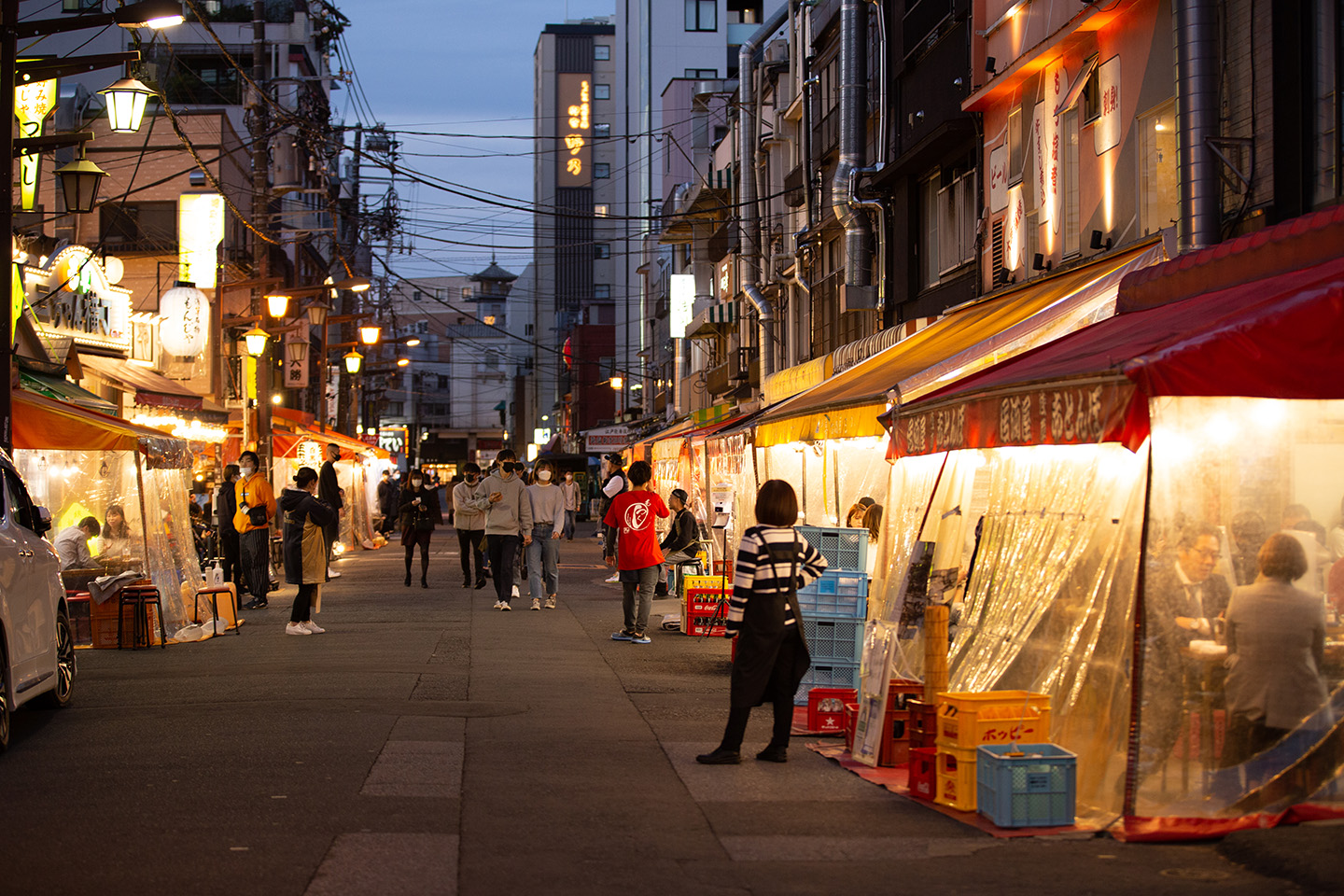
Hoppy Street is a short pedestrian alley running off Hanakawado-dori that has been the working-class drinking heartland of Asakusa since the immediate postwar years. The street takes its name from Hoppy, a low-alcohol malt beverage launched in 1948 as an affordable substitute for beer during the years of food and drink scarcity — it was cheap, it mixed well with shochu, and it became inseparable from the culture of Asakusa's outdoor izakayas. The drink almost disappeared in the 1980s as prosperity made real beer universally affordable, but a revival movement in the 1990s and 2000s brought it back, and the street that bears its name has become one of the most photographed corners of old shitamachi Tokyo.
The handful of open-air izakayas that line both sides of the alley operate on a system barely changed in seventy years: plastic stools pulled directly onto the pavement, charcoal grills loaded with yakitori and motsu (offal skewers), and the drinks brought out in a specific ritual — a frosted glass packed with ice, a measure of shochu poured in, and then the Hoppy added cold, the ratio a matter of local pride. The clientele is a cross-section of Asakusa: elderly men who have been coming here since it opened, younger Tokyoites in search of authenticity, and the occasional chef on a day off who knows that this kind of cooking is harder to find than it looks.
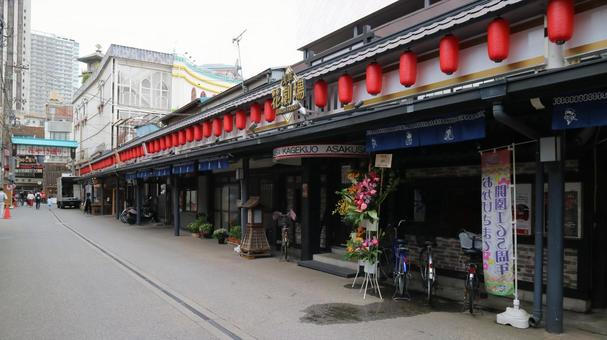
Hanayashiki opened in 1853 as a botanical garden — a fashionable leisure destination in the final years of the Edo period when Asakusa was already the most popular entertainment district in the shogun's capital. It gradually added mechanical rides and carnival attractions through the Meiji and Taisho periods, reinventing itself each decade while retaining the intimate, slightly ramshackle character that still defines it today. The grounds cover barely 5,000 square metres, making it the smallest amusement park in Japan as well as the oldest, and everything about it — the hand-painted signage, the aged metal of the rides, the sound of the old machinery — communicates a cheerful indifference to modernity.
The roller coaster, built in 1953 and officially the oldest operating coaster in Japan, reaches a maximum speed of 42 kilometres per hour and completes its circuit in under 60 seconds — which is somehow both exactly as long as it needs to be and slightly too short. The ghost house, the shooting gallery, the rickshaw rides, and the small stage where performers work the crowd on weekend afternoons all belong to a tradition of popular entertainment that has almost entirely vanished from every other city in Japan. Most visitors to Asakusa walk straight past the entrance without noticing it exists; the crowds queue at Senso-ji while Hanayashiki sits largely unhurried a hundred metres away.
Rokku — Asakusa's Sixth District — was Tokyo's first and for decades its most important entertainment quarter, predating every other famous district in the city by generations. From the late Meiji era through the 1960s it housed an extraordinary concentration of theatres, cinemas, music halls, vaudeville stages, and strip shows that drew millions of visitors and launched careers that shaped Japanese popular culture: the actress Misora Hibari performed here as a child prodigy, comedian Roppa Furukawa built his following in these theatres, and the traditions of rakugo, manzai, and enka that still define Japanese entertainment today were refined on Rokku's stages.
The postwar decades were Rokku's golden age and its beginning of decline simultaneously. Television drew audiences away from live performance through the 1960s and 70s, and the district never fully recovered the density of entertainment it had once maintained. What remains today is a quieter version of the same streets — a few surviving theatres, the Asakusa Engei Hall still presenting rakugo daily, some of the old cinema buildings repurposed or standing empty, and the particular quality of faded grandeur that attaches to places that once burned very brightly. Walking these blocks with Terry, who can place every building in its historical context, gives the whole neighbourhood a depth that no guidebook quite captures.
Kappabashi — officially Kappabashi Dougu-gai, the Kitchen Tool Street — is a 170-shop wholesale district that has supplied Tokyo's restaurants with professional-grade equipment since the early 20th century. The street takes its name from a bridge (kappa-bashi, "raincoat bridge") that once crossed a canal here, but it has been associated with the trade in kitchen supplies since around 1912, when a local merchant named Niimi Taro began selling surplus cookware from his shop and the surrounding streets gradually filled with similar specialists. The result, over a century later, is an entire kilometre of shops selling everything a professional kitchen could require: handmade knives, clay pots, cast iron, copper cookware, lacquerware, ceramics, restaurant signage, plastic food display models, bamboo steaming baskets, and industrial-scale equipment for businesses that would be hard to source anywhere else on earth.
For visitors, the most compelling stops are the knife specialists. Several shops on the street stock — and sell directly to the public — the handmade knives produced by traditional smiths in the Sakai district of Osaka and in Seki in Gifu Prefecture: single-bevel yanagiba for slicing sashimi, heavy deba for breaking down whole fish, thin usuba for cutting vegetables without bruising them, and general-purpose gyuto chef's knives forged from steel that takes and holds an edge no factory blade can match. Terry knows which shops are worth spending time in, which smiths make which blades, and how to navigate a purchase that will still be usable decades from now.
Comfortable walking shoes recommended — this is a full-day route covering significant ground.
* Terry's personal transit, admissions & meals are also included — no hidden costs on the day.
Everything is covered in your flat rate — no out-of-pocket costs on the day. Terry pays all entry tickets and dining tabs quietly in the background.
Comfortable walking shoes recommended — this is a full-day route covering significant ground across Asakusa and Kappabashi.
Every Asakusa & Kappabashi tour is built around your interests. Serious about knives? Terry can arrange direct access to working blade smiths. More interested in temple history? The pace slows and the stories deepen. You set the agenda.